

Quantum Executive Director, Steven Beaumont, looks at different sectors in the construction industry and discusses how we can all relate to the problems they face more than you might think.
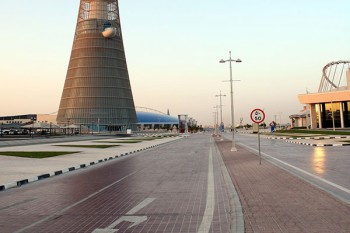
Roads are an essential tool for everyday life to operate; roads are actually an asset to a nation and its economy. In their most basic form, roads are simple corridors to move people and goods safely from A to B and then onto C. I say safely if the rules of the road are adhered to, but all too often the rules are broken leading to minor and major accidents. I use the word ‘accident’ loosely because the broken rule has resulted in a breach of the law, not an ‘accident’. Around Doha there are some significant ongoing road projects allowing us to move around and hopefully ease the congestion.
Building a road is quite a simple construction process, bridges and flyovers are a little more complicated pieces of the jigsaw but as I have said before, it isn’t rocket science. The planning of a road is however different from that of a building or a structure. You see a simple building will have a footprint and a height, a road on the other hand moves over the land that takes into account the different geographical and environmental features so the route of the road is the most efficient.
Roads can be designed and built using a variety of construction methods such as tarmac and concrete. But for the purposes of this article let’s consider tarmac – this was patented by Edgar Hooley in 1901 as a construction material, a few years later in May 1904 two gentlemen called Charles Rolls and Henry Royce were having lunch and agreed to build a motor car. So, we have the chap who knows how to build the road, and the two chaps who know how to build a car to go on the road. Are you with me so far?
“We are all relying on technology to make our world more efficient and technology has also had a huge impact on cars, I mean, did you ever think a car could park itself?”

Technology has moved on significantly since this era and I heard recently that Mr Rolls and Mr Royce’s company are experimenting with 3D printing of fan blades. This isn’t too dissimilar from how we work in managing construction disputes, before the introduction of computers we used a quill which developed into a pen and now we make animated visual presentations to do what the quill once did. We are all relying on technology to make our world more efficient and technology has also had a huge impact on cars, I mean, did you ever think a car could park itself? It can now.
The drivers of cars on the roads are the customers, and if the customer cannot get to his or her destination in a reasonable time, they become frustrated. We often have the driver (and there are a few like this in Doha) who thinks he is the only person on the road, he might have a sun blind in the driver’s side window for some reason so he cannot see and he thinks he is the only person on the road. You have seen him as well haven’t you!
This sort of issue leads to disputes on the road which really is avoidable. It isn’t unreasonable for the road user to travel without problems but the more vehicles allowed onto the road will result in the road capacity reaching its limit and then we have congestion.
As with many construction projects, roads are not shy when it comes to disputes and just turning back to the construction of a road for a moment, underground obstacles and problems can cause a road project to suffer from delays.
If, or should I say when an underground problem occurs, there are mechanisms within the contract to deal with this so the problem is managed and the project overcomes the issue. However, we do have the same issue of poor correspondence which records, or is supposed to record the problems. Then we have the argument about whose risk the problem is, which turns into a dispute, then I get a phone call. But why? One wouldn’t be wrong to think with technology rapidly developing the world we live in the construction of road could be done easily without any problems or disputes, I mean, just look at the technology in cars, I don’t think Henry Rolls or Charles Royce would believe that a car can park itself these days.
We can see why there are disputes on the road with users not thinking and driving dangerously, but the construction of a road and any problems which may occur should be avoidable – all we need to do is get the stakeholders to a road project, that is the client and the contractor to work together and manage the risks correctly.
The three gentlemen, Mr Hooley, Mr Rolls and Mr Royce didn’t envisage that their masterpieces of work would lead to some disputes and as technology has advanced so should the construction process of a road – from the feasibility, the design through construction to the user driving on it, disputes can be avoided.
“The drivers of cars on the roads are the customers, and if the customer cannot get to his or her destination in a reasonable time, they become frustrated”
 Steven Beaumont, Executive Director
Steven Beaumont, a Quantum Executive Director, is a member of the Royal Institute of Chartered Surveyors and the Chartered Institute of Arbitrators. Steven has over 20 years of experience in both local and international construction project disputes and regularly delivers construction claims classes and lectures to industry professionals throughout the GCC. QGS is acknowledged as one of the leading management consultancies dedicated to serving the interests of national and international construction and engineering organisations.
Read more INSIGHT articles.
This article was previously published in the April 2015 edition of Business@Qatar Magazine published by the Gulf Times Newspaper.